How Many Hours a Day Should Heating Be On in the UK?
For many households, the question of how many hours a day heating should be on in the UK becomes more important as soon as temperatures drop. Energy costs, insulation levels, working patterns and family comfort all affect the answer. In most homes, the best approach is not to leave the heating running without control, but to use a timer, room thermostat and radiator valves to warm the property when people need it most. If your system struggles to heat rooms evenly, speaking with Central Heating Engineers in London can help you understand whether the issue is timing, controls, boiler performance, radiators or pipework. VR Central Heat also supports homeowners looking for Reliable Plumbing and Heating Solutions in London for everyday comfort, repairs and heating efficiency.
There is no single number of hours that works for every UK property. A modern, well-insulated home may stay warm with shorter heating periods, while an older London house with draughts, solid walls or single-glazed areas may cool down quickly. A flat in a managed block can behave differently from a detached house, and a household with elderly residents or young children may need more consistent warmth than a home occupied only in the evenings.
This guide explains practical heating schedules, thermostat settings, room-by-room comfort, damp prevention and signs that your heating system may need professional attention.
Heating Hours Infographic for UK Homes
This quick visual guide summarises the main points of the article, including typical heating patterns, thermostat guidance, energy-saving tips and signs that your system may need professional attention.
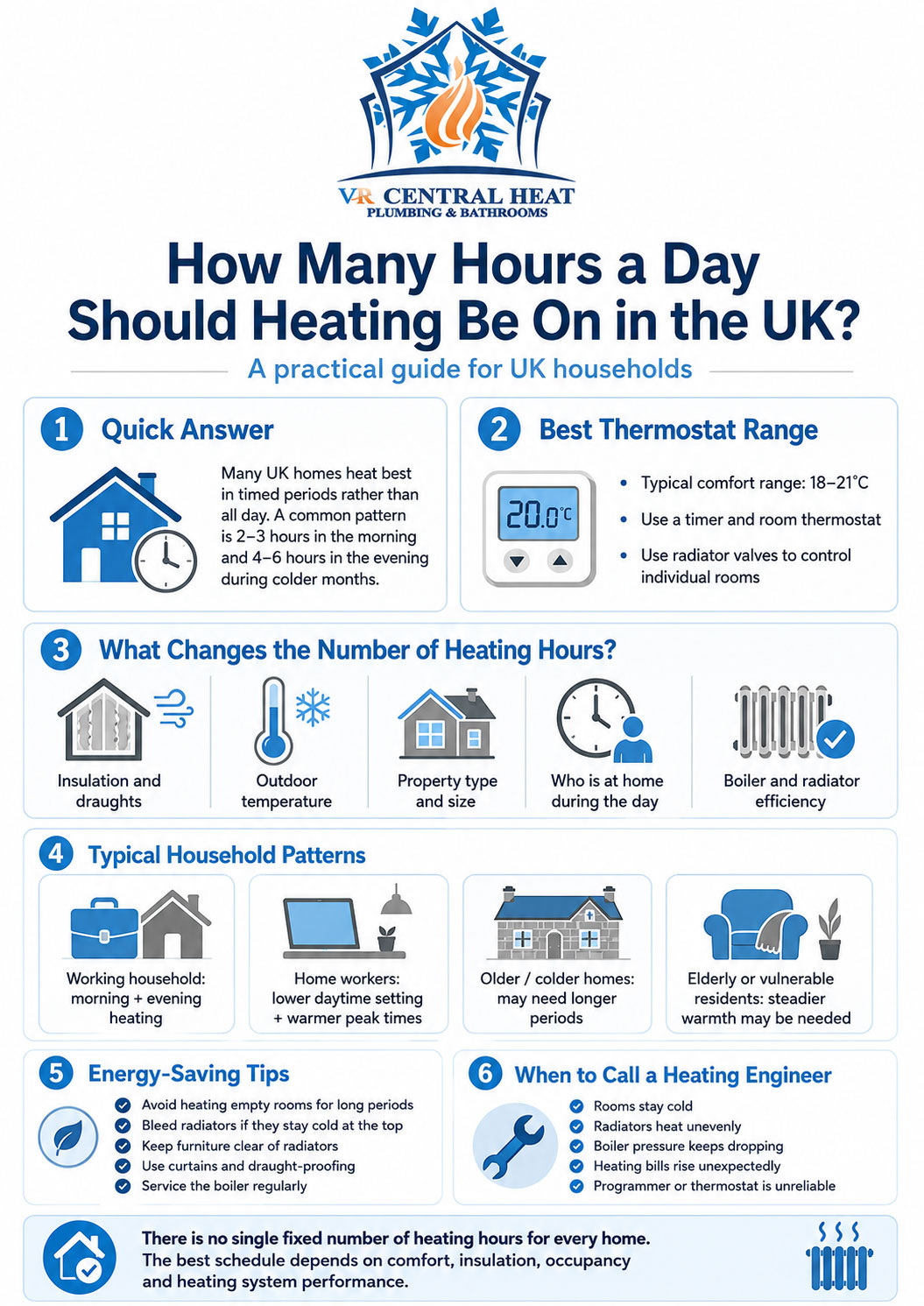 Click the infographic to view it larger
The Short Answer for UK Homes
For many UK homes, heating is commonly used for a few hours in the morning and again in the evening during colder months. A typical working household may use central heating for around 2 to 3 hours in the morning and 4 to 6 hours later in the day, depending on the weather, insulation and occupancy. This is only a practical guide, not a strict rule.
The aim should be to keep the home comfortable when it is occupied, rather than heating empty rooms unnecessarily. If someone is at home all day, the heating pattern may need to be different. Instead of long uncontrolled heating, many homes benefit from a lower background temperature and scheduled warmer periods.
The most important point is that heating hours should work with your thermostat. If the thermostat is set correctly, the boiler should stop firing when the room reaches the chosen temperature. This means the system is not simply running for the full scheduled period at maximum output.
- Use a timer to heat the home before key daily routines
- Avoid heating empty rooms for long periods
- Set comfortable room temperatures rather than guessing hours
- Adjust schedules during very cold weather
- Use radiator valves to control individual spaces
- Review your boiler and controls if rooms heat unevenly
Why There Is No Fixed Rule for Heating Hours
The number of hours your heating should be on depends on how quickly your home loses heat. Heat loss is affected by insulation, glazing, wall type, roof space, draughts, room size and the condition of the heating system. Two properties on the same London street can need very different heating schedules.
Older UK homes often have features that make heating more challenging. Solid walls, suspended timber floors, unused chimneys, older windows and draughty doors can allow warmth to escape. In these homes, short heating bursts may not be enough during very cold weather unless insulation and draught-proofing are improved.
By contrast, a newer or well-insulated property may retain heat for longer. Once the rooms reach a comfortable temperature, the heating may only need to top up warmth at intervals. This is why the thermostat setting, the speed of heat-up and the way the home cools down are more useful than a single daily hour count.
Suggested Heating Schedules for Different Households
A good heating schedule should match the way people live in the property. The table below gives practical examples for UK homes. These examples are not medical or financial advice, but they can help homeowners think about heating in a more structured way.
| Household Type |
Possible Heating Pattern |
Practical Notes |
| Working household |
Morning warm-up and evening heating |
Often suitable when the home is empty during the day |
| Home workers |
Lower daytime setting with warmer morning and evening periods |
Heat occupied rooms rather than the whole property if possible |
| Family home |
Morning, after-school and evening heating periods |
Comfort may be needed at different times across the day |
| Elderly or vulnerable residents |
More consistent warmth across the day |
Cold homes can be a health risk, so comfort and safety matter |
| Well-insulated modern property |
Shorter timed periods with thermostat control |
The property may retain heat well once it is warm |
| Older draughty property |
Longer heating periods plus draught-proofing improvements |
System checks and insulation upgrades may be needed |
The best schedule is the one that keeps key rooms comfortable without wasting energy. If you constantly need long heating periods but still feel cold, the issue may be heat loss, poor radiator performance, incorrect balancing or an ageing boiler.
Thermostat Settings Matter More Than Hours Alone
Many people focus only on the number of heating hours, but thermostat settings are just as important. In many UK homes, a thermostat setting around 18°C to 21°C is considered a common comfort range. Some people prefer a slightly cooler home, while others need more warmth because of age, health or mobility.
A room thermostat should normally be placed away from direct sunlight, radiators, draughts and appliances that produce heat. If the thermostat is in a cold hallway, the boiler may run for longer than necessary. If it is near a warm radiator or sunny window, the heating may switch off before living areas are comfortable.
Thermostatic radiator valves can also help. They allow you to reduce heat in spare bedrooms, hallways or rooms that are not used often, while keeping living areas warmer. This can improve comfort and reduce unnecessary heating.
- Set the thermostat to the lowest comfortable temperature
- Keep the thermostat away from draughts and heat sources
- Use radiator valves to manage room-by-room warmth
- Do not block radiators with large furniture
- Bleed radiators if the top stays cold
- Ask an engineer if one room never heats properly
Is It Cheaper to Leave Heating On All Day?
For most standard gas central heating systems in the UK, leaving heating on low all day is usually not the most economical approach. A home continuously loses heat through walls, windows, floors, roofs and gaps. The longer the heating is on, the longer the system has to replace that lost heat.
However, there are exceptions. Some homes with serious damp issues, vulnerable residents or certain heating technologies may need a different strategy. Heat pumps, for example, can work differently from traditional boiler systems and may perform best with steadier operation. This is why it is important to understand the type of heating system installed in your home.
For a typical boiler and radiator system, a sensible starting point is to use timed heating periods, then adjust based on comfort. If the home becomes uncomfortably cold between heating periods, consider improving draught-proofing, radiator performance or insulation rather than simply extending heating hours every day.
Heating, Condensation and Damp Prevention
Heating is not only about comfort. In UK homes, especially during winter, very cold surfaces can contribute to condensation when warm, moist air meets them. Condensation can appear around windows, external walls, corners, bathrooms and poorly ventilated spaces.
Keeping a home warm enough, ventilated and properly maintained can help reduce the conditions that allow damp and mould to develop. Heating alone is not always enough. Moisture from cooking, showering, drying clothes indoors and poor ventilation can still create problems.
A balanced approach is usually best: maintain a reasonable indoor temperature, use extractor fans, open trickle vents where suitable, avoid drying clothes on radiators where possible, and keep air moving. If mould keeps returning despite good habits, there may be a building, ventilation, leak or heating issue that needs investigation.
- Keep key rooms warm enough during cold weather
- Use bathroom and kitchen extractor fans correctly
- Wipe window condensation when it appears
- Avoid blocking airflow behind furniture
- Check for leaks or hidden plumbing problems
- Do not ignore persistent mould or damp patches
Why London Homes Often Need a Different Heating Approach
London properties vary widely. A Victorian terrace in Highgate, a converted flat in Islington, a family house in Muswell Hill and a modern apartment may all respond differently to heating. Building age, layout and insulation can make a major difference.
Converted flats can be especially difficult because pipe runs, radiator positions and room layouts may have changed over time. Some rooms may overheat while others remain cold. Large bay windows, high ceilings and older external walls can also increase heat loss.
In these homes, the answer is not always to keep heating on for more hours. The better solution may involve radiator balancing, boiler servicing, flushing the system, improving controls or replacing inefficient radiators. A professional assessment can identify whether the heating schedule is the real issue or whether the system itself is underperforming.
Signs Your Heating System Needs Checking
If your heating needs to be on for many hours but your home still feels cold, your system may not be working efficiently. A boiler and radiator system should heat rooms steadily and consistently when properly sized, maintained and balanced.
Common warning signs include radiators that stay cold at the bottom, noisy pipes, frequent boiler pressure drops, rooms that never reach temperature, heating that cuts out, or hot water problems at the same time as central heating issues. These symptoms can point to trapped air, sludge, poor circulation, faulty controls, pump issues or boiler faults.
It is also worth checking whether your programmer and thermostat are being used correctly. Many heating problems are made worse by outdated controls, confusing timer settings or thermostats that no longer read temperatures accurately.
- Radiators take too long to heat up
- Some rooms stay cold even when heating is on
- The boiler pressure keeps dropping
- The system makes banging or gurgling noises
- Heating bills rise without a clear reason
- The thermostat or programmer is unreliable
Practical Ways to Use Heating More Efficiently
Before increasing heating hours, look for simple improvements that help the home hold warmth for longer. Draught-proofing doors, closing curtains at night, keeping radiators clear, using radiator valves correctly and servicing the boiler can all support better performance.
If your boiler has not been serviced for a long time, it may not be working as efficiently as it should. Radiator sludge can also reduce heat output, making the system run longer for weaker results. In some cases, a power flush or system clean may improve circulation, but this should be assessed properly before any work is agreed.
Smart thermostats can help some households by making schedules easier to control. However, smart controls are only useful when the heating system itself is healthy and the property is reasonably well managed. Technology cannot fully compensate for poor insulation, undersized radiators or a faulty boiler.
- Service your boiler regularly
- Bleed radiators when needed
- Use curtains to reduce night-time heat loss
- Keep sofas and furniture away from radiators
- Use timer settings that match your routine
- Improve draught-proofing before extending heating hours
Final Advice: How Many Hours Should Heating Be On?
As a practical answer, many UK households can start with heating on for timed periods in the morning and evening, then adjust depending on comfort, outdoor temperature and how quickly the home cools down. For some homes this may be around 6 to 8 hours in colder weather; for others it may be less or more. The key is to combine sensible timing with thermostat control, radiator valves, good ventilation and regular heating maintenance.
If your home only feels warm when the heating is on for most of the day, it is worth asking why. The issue may be heat loss, radiator performance, boiler condition, poor controls, pipework restrictions or system imbalance. Solving the cause can be better than simply paying for longer running times.
For homeowners who want help understanding heating performance, comfort and efficiency, Your trusted heating experts in London can inspect the system and recommend practical improvements. Whether you need boiler care, radiator checks, controls advice or Reliable Plumbing and Heating Solutions in London, VR Central Heat can help you keep your home warmer, safer and more comfortable through the colder months.
Need Help With Your Heating in London?
VR Central Heat provides professional heating and plumbing support for London homes, including boiler services, radiator checks, heating controls and central heating repairs.
Book trusted heating support for a warmer, more efficient home.